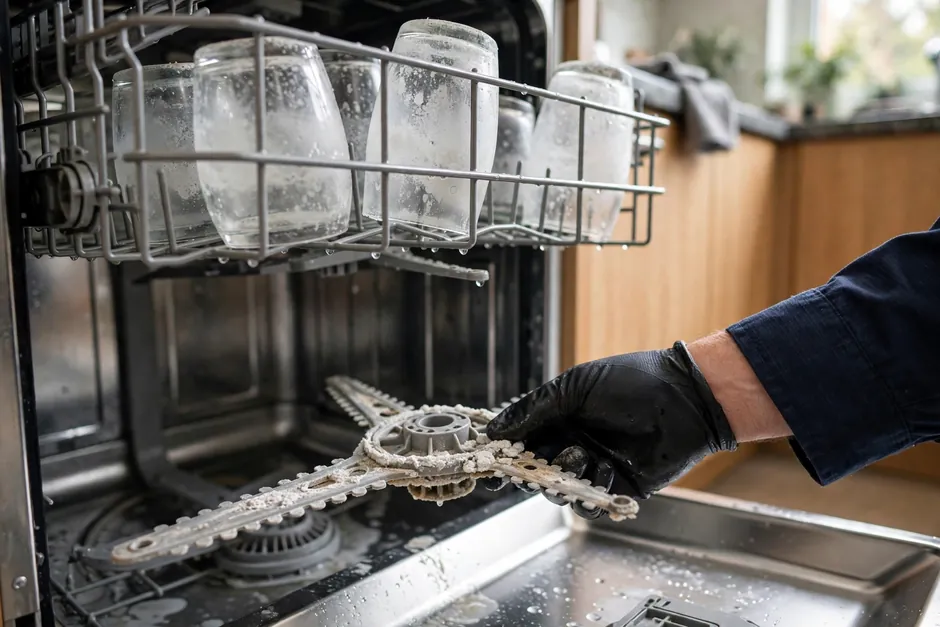
In Williamson County, a dishwasher that stops cleaning is usually being choked by hard-water scale: spray arm jets narrow, the inlet screen clogs, and the heater crusts until wash water runs cooler and weaker. Add detergent dosing mistakes and a neglected filter, and most 'failing' dishwashers turn out to be healthy machines losing a fight with local water, a fight a descale routine and correct dosing can win.
Separate the three dirty-dish problems
Grit and food residue mean wash action or filtration is failing: filter clogged, spray arms not spinning, or water level low. White film means minerals or etching (see the vinegar test in our hard-water appliance article). Dull, spotted-but-clean dishes mean rinse aid and drying settings. Each has a different fix, and treating film like a wash failure wastes a service call.
Quick home checks: spin each spray arm by hand (they should rotate freely), pull and rinse the bottom filter, and confirm the water at the kitchen tap runs hot quickly, since a dishwasher filled with cool water washes badly no matter its health.
The descale routine that restores wash power
Remove the spray arms if your model allows (many lift or unscrew) and clear each jet with a toothpick, then soak them in vinegar to dissolve the scale necks inside. Run an empty hot cycle with a citric-acid dishwasher cleaner. Repeat the arm check in a month: if jets re-clog that fast, your scale load is heavy and the routine becomes a standing appointment on the calendar.
Pair it with dosing discipline: detergent measured for hard water and load soil, rinse aid kept full, and the machine's water-softener setting (many models have one) actually set. Half the film complaints we visit are a softener setting still at factory zero on Williamson County water.
When it is the machine after all
If arms are clear, the filter is clean, water arrives hot, and dishes still emerge dirty, suspect the wash pump losing pressure or the inlet valve starving the fill, both of which we test directly on our dishwasher repair page. Weak wash motors fade gradually, exactly like scale, which is why the free checks come first: they clear the innocent so the guilty can be proven.
A machine that also drains poorly is telling a different story: drain faults undermine wash quality by leaving dirty water in the sump. Fix order matters, drain first, then judge the wash. That sequence is the quiet difference between diagnosis and parts-swapping.