Wine Coolers & Beverage Centers
Wine Cooler & Beverage Center Repair in Thompson's Station, TN
Appliance trouble in Thompson's Station? We diagnose first, quote before we repair, and test everything before we leave.
Serving Thompson's Station & Williamson County · Mon–Fri 7AM–7PM · Sat 8AM–4PM · 24/7 Emergency
The Short Answer
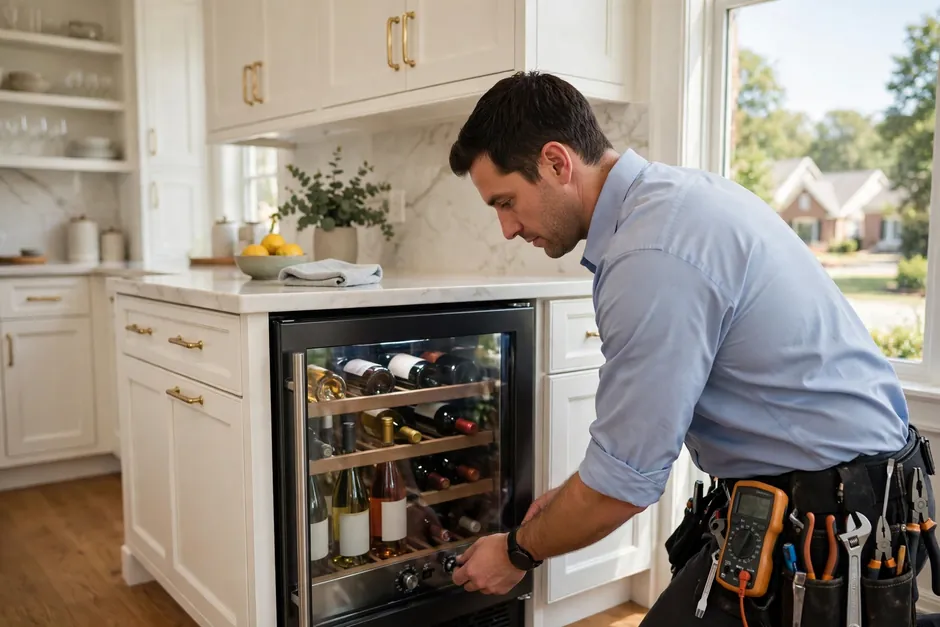
A wine cooler that drifts warm, runs constantly, or ices up usually has a fan, sensor, or door seal problem, and small thermoelectric units fail differently from compressor models. We identify which cooling type you own, test its specific weak points, and quote the repair before ordering parts.
Wine coolers and beverage centers live a harder life than they look. They sit in warm kitchens and butler's pantries, get opened constantly during gatherings, and hold temperatures far below room level with small cooling systems that have little reserve. In the larger homes of Bridgemore Village, Canterbury, and Whistle Stop Farms, built-in beverage centers are standard equipment, and their failures follow a pattern.
Compressor-based units share DNA with refrigerators and fail like them: fans, sensors, defrost issues. Thermoelectric units, common in small countertop coolers, fail at the cooling module or its fan and cannot be repaired the same way. Step one is knowing which one you own.
We service built-in and freestanding wine and beverage units, including dual-zone models, from most major brands. Learn more on our brands we service page, and check the manufacturer's own resources at GE Appliances owner's resources.
Symptoms We Hear
Signs You Need This Service
- Temperature drifting up or swinging widely
- Runs constantly and never rests
- Ice or frost forming on the back wall inside
- Condensation on the glass door
- Loud fan noise or a new vibration
- Display shows an error or a temperature that doesn't match a thermometer
Symptom → Cause → Fix
What We Usually Find
| Symptom | Likely Cause | What We Do |
|---|---|---|
| Warm and running constantly | Failed circulation fan or a worn door gasket | We test fan operation and run a gasket seal check |
| Frost on the back wall | Door left ajar repeatedly or a defrost/sensor fault on compressor models | We check sensor readings and door alignment |
| Condensation on glass | High room humidity overwhelming the door heater or seal | We inspect the gasket and door heater circuit where fitted |
| Display wrong | Sensor drift or a failing control | We compare a calibrated thermometer against the sensor reading |
| Dead cooling, thermoelectric | Peltier module or its cooling fan failed | We test module power and fan function; modules are replaceable on many models |
Likely causes are starting points for testing, not promises. We confirm the failed part with instruments before quoting.
How We Fix It
Our Diagnostic Process
Type identification
Compressor or thermoelectric, built-in or freestanding: the diagnosis path depends on it.
Temperature verification
We log actual shelf temperatures against the display before touching parts.
Component testing
Fans, sensors, gaskets, and controls get tested in the order the symptom suggests.
Stabilization check
We confirm the unit pulls down and holds its set point through a full cycle.
Repair or Replace?
Fans, gaskets, sensors, and controls are worthwhile repairs on built-in units, which are costly to replace and sized to the cabinetry. On small countertop thermoelectric coolers, a failed module can approach the price of a new unit, and we will say so plainly rather than sell a repair that makes no sense.
| Problem | Repair Makes Sense When | Replacement Wins When |
|---|---|---|
| Circulation fan or gasket | Repair, common and moderate | Not applicable |
| Temperature sensor or control | Repair on built-in models | Weigh on small countertop units |
| Thermoelectric module | Repair if parts are available | Replacement often wins on budget coolers |
| Compressor or sealed system | Repair on premium built-ins | Replacement on most freestanding units |
For typical price ranges and the thinking behind them, see our appliance cost guide and the appliance lifespan chart. For the checks you can do safely before booking, see before you call.
Wine Cooler & Beverage Center Repair in Thompson's Station
Built-in beverage centers show up in the entertaining spaces of Bridgemore Village, Avenue Downs, and Fountain View homes, often near outdoor kitchens where summer heat pours in every time the door opens. Garages are the other local pattern: a cooler in a 100-degree Williamson County garage in August is working at its design limit, and placement advice is part of the visit.
Related Services & Guides
All Makes & Models
Brands We Service
We service these brands and many more. Not sure about yours? Call (615) 583-1836 or see our full brands page.
Frequently Asked Questions
For long-term storage, about 55 degrees is the classic target. Serving temperatures vary: whites colder, reds slightly warmer, which is why dual-zone units exist. What matters most for repair is stability; a unit swinging 8 degrees during the day has a problem even if the average looks right.
Summer humidity in Middle Tennessee condenses on cold glass when the door seal leaks or the door heater (where fitted) fails. Wipe it dry and watch how fast it returns. Fast return means warm air is getting in, and the gasket or door alignment needs attention.
It can, but expect strain. Most residential coolers are rated for indoor ambient ranges, and a Thompson's Station garage in August can exceed them, while a January cold snap can confuse sensors the other way. If yours lives in a garage, tell us, because it changes what 'normal' readings look like.
A new noise usually means the circulation or condenser fan is hitting something, has a failing bearing, or the unit is no longer level after being nudged. Note whether the noise stops when you press on the cabinet; that detail helps us pinpoint it quickly.
Usually, yes. The zones share some parts and have their own fans and sensors, so one warm zone often traces to that zone's fan or sensor. We test each zone separately and log both temperatures before quoting.
The cooling principles overlap, but the parts are smaller, the temperature targets are warmer and tighter, and built-in units need cabinetry care during service. Thermoelectric models are different again. It is a specialty visit, not just a small fridge call.
Ready When You Are
An Appliance Down in Thompson's Station?
One call gets a technician on the way. We serve all of Thompson's Station and Williamson County, Mon–Fri 7AM–7PM, Sat 8AM–4PM, with 24/7 emergency service.
Mon–Fri: 7AM – 7PM · Sat: 8AM – 4PM · 24/7 Emergency